
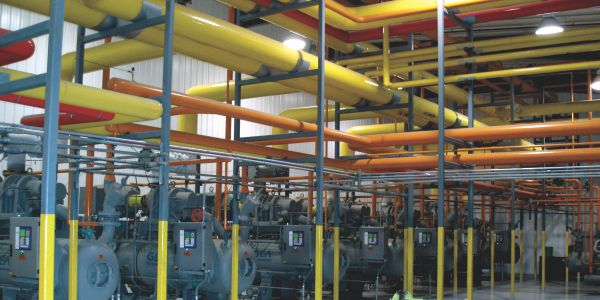
Process Monitoring and Control
You want your operation — whether it’s food manufacturing, freezing, cold storage, packaging, or another automated process — to be accurately monitored and controlled. Empire Control Systems incorporate state-of-the-art technology to provide the precision you need, and the ability to see exactly how your process is doing at a glance.
Temperature, pressure, level, flow, speed, oxygen or carbon dioxide gas concentration, ammonia detection, energy consumption, production totalization — whatever your process requires, our PC-based system can handle it efficiently, accurately, and reliably.
Manage your process with highly accurate sensors and intelligent PID logic to precisely control fans, valves, motors, actuators, and other devices. Incorporate variable-speed technology for fine control, energy efficiency, a quieter and more comfortable environment, and other benefits.
Enjoy the ability to really “see” what is happening in your facility. Strategically placed sensors give you visibility into your process never before possible. Greater efficiency, increased production, reduced product loss, and reduced maintenance are routinely realized after installing an Empire Controls monitoring and control system.
If you’ve got a process, we’ve got a system to accurately monitor and control it.
Condenser Monitoring and Control
Auto Discharge Pressure Setpoint
Ambient temperature and relative humidity readings are used to calculate the wet-bulb temperature — the ideal limit for evaporative cooling — which is then used to determine the discharge pressure setpoint. This setpoint is constantly recalculated to utilize all the available condensing capacity under the current ambient conditions. The minimum discharge pressure setpoint is user adjustable.
Condenser Fan Sequencing
Condenser fans sequence on when the discharge pressure is above setpoint for a time-delay period, and sequence off when the pressure falls below setpoint. Fans are typically set up so they come on in order of smallest to largest. Under heavier load conditions this order can be reversed, allowing the larger fans to come on first. When two fans are of similar size, either can be selected as the lead fan.
Variable Speed Control
Condenser fans can be operated over a range of 0–100% of full speed. This takes advantage of the cubic fan law: the power required to drive the fan varies as the cube of the speed. In other words, energy consumption drops off dramatically as the speed is reduced.
Variable-speed technology is well suited for condenser fans because all available fans can run together at the same speed, utilizing the entire surface area of the coils while dramatically reducing power consumption. Intelligent control algorithms operate the fans at the speed required to match the refrigeration load, eliminating the need to continually start and stop motors to control capacity.
Condenser Pumps
The user enters the start and stop pressures of each pump. Generally the pumps run all the time, but in cold weather the pumps will sequence off when the discharge pressure falls below the stop setpoints. When the pressure rises again, the pumps will sequence back on according to their start setpoints.
Non-Condensables
Non-condensables are detected by comparing the discharge pressure with the pressure corresponding to the measured liquid condensate temperature. A gauge on the condenser control screen displays the non-condensable pressure so the user knows when purging is required.
Compressor Monitoring and Control
Auto Suction Pressure Control
Every refrigeration system has specific requirements for suction pressure. However, those requirements may change significantly depending on the season, product, ambient temperature, and other factors. If the suction pressure is too high, zone temperatures will not be maintained at setpoint. If the suction pressure is lower than necessary, energy efficiency and compressor capacity are unnecessarily degraded. Auto suction pressure control optimizes compressor operation by automatically determining the best suction pressure for the existing conditions.
Capacity Control
Whatever the suction pressure setpoint, operating compressors will efficiently load or unload in a coordinated pattern as the pressure varies. Generally, the largest compressor loads first, followed by the next largest, and so on. Unloading follows the reverse order.
Screw compressors load or unload as determined by a Proportional, Integral, Derivative (PID) algorithm that considers a number of factors to calculate the rate at which capacity is changed. To minimize slide-valve position “hunting,” the control system suspends capacity adjustments when the pressure is within the user-determined deadband setpoints.
Variable-speed technology is well suited for capacity control as well. Intelligent control algorithms operate the compressor at the speed required to match the refrigeration load, eliminating the need to continually adjust the slide valve. The slide valve can remain 100% loaded while motor speed varies for maximum efficiency.
Flexible Compressor Sequencing
An important function of intelligent compressor control is determining which compressors will operate for a given refrigeration load. We provide an easily configured matrix that allows complete flexibility in selecting the compressors that will operate at each sequence step. If a compressor is out of service or the facility load pattern changes, the sequence steps can be redefined with a few clicks.
The sequencer steps up when the suction pressure is above setpoint, and steps down when the system detects that the load on the operating compressors is small enough to be handled by the next lower step. All sequencer parameters — pressure deviation, tonnage differential, time delays — are user adjustable for customized tuning.
Alarm Conditions
The system continuously monitors the compressors for fail-to-start and slide-valve fail-to-load conditions. If either alarm occurs, the operator is immediately notified to prevent out-of-spec conditions in the facility.
System-Wide Approach
Look at the “big picture” and control your compressors as part of the overall system, not as individual pieces of equipment. Keep the heart of your system operating at maximum efficiency and reliability. You won’t believe how simple it is to select capacity control and compressor sequence parameters that fit your plant’s changing needs — making sure you have the capacity you need, when you need it, without wasting energy or accumulating unnecessary run hours on compressors.